In mining, every decision carries real weight, whether it’s continuing an exploration programme, adjusting a drilling campaign or investigating a new target, the quality and speed of geological information can influence both costs and outcomes.
As exploration projects become more data-driven, technologies that deliver reliable insights faster are helping teams make confident decisions without slowing progress.
The Cost of Waiting for Answers
Every mining project starts with questions.
Is this the right target? Are we seeing the alteration we expected? Should we continue drilling, or is it time to move on?
For decades, answering those questions has often meant waiting. Drill core is recovered, logged, sampled, sent away for analysis and eventually worked into geological models.
This process works, but it isn’t always quick, and by the time the results come back, drilling may have already continued, budgets have grown and ultimately valuable time has passed.
Now imagine having far more confidence in those decisions while the project is still moving.
Looking Beyond What the Eye Can See
This is where hyperspectral rock analysis starts to make a real difference.
The human eye can only tell you so much, but hyperspectral technology looks much deeper, measuring hundreds of wavelengths of reflected light to identify minerals and subtle geological changes that would otherwise be easy to miss, so rather than replacing the geologist, it gives them another reliable source of information to support their interpretation.
Perhaps the biggest advantage isn’t the technology itself. It’s being able to access that information while decisions can still be made, rather than weeks or months later.
Faster Decisions Mean Better Outcomes
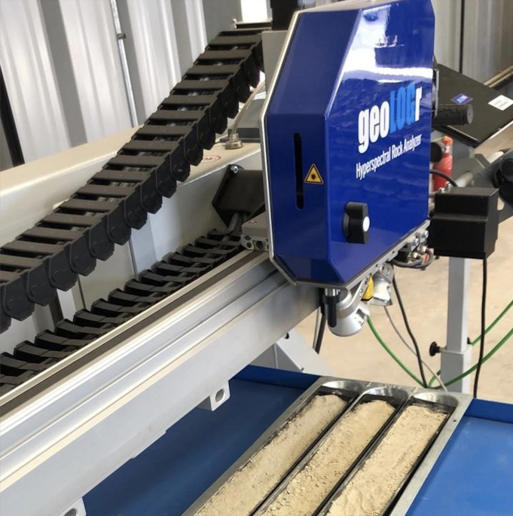
With systems such as the geoLOGr®, drill core can be scanned in a continuous, non-contact process while high-resolution imagery and hyperspectral data are collected at the same time. Instead of waiting weeks or even months for information to filter through multiple stages of interpretation, geological teams receive standardised outputs in a matter of days.
That can make a real difference over the course of an exploration programme.
Not every drill hole tells the story you expect. Sometimes the data confirms your thinking, and sometimes it sends the team back to ask new questions. Getting those answers earlier leaves far more room to respond.
Mobility Without Compromising Confidence | HHS
While systems such as the geoLOGr® are designed to deliver high-throughput hyperspectral analysis of drill core, not every geological decision happens back at camp or in the core shed. Exploration teams often need answers while they’re still in the field, whether they’re reviewing RC chips, investigating outcrops or assessing new targets.
That’s where the Hyperspectral Handheld Scanner™ (HHS) comes in.
Designed as a portable hyperspectral solution, the HHS allows geologists to capture high-quality hyperspectral measurements directly from rock surfaces using a compact handheld scan-head.
The collected data is securely uploaded to the cloud, where it is processed through the Lithotype™ workflow before being returned as standardised, decision-ready information that integrates with existing geological software.
For exploration programmes operating across remote regions of Africa, mobility can be just as important as speed. Rather than transporting samples or waiting for additional logging, teams can quickly validate rock types, alteration and mineralisation closer to the point of collection.
This helps maintain momentum, reduces unnecessary re-logging, and most importantly gives project teams greater confidence when making go or no-go decisions!
The HHS is also available as a rental solution, making advanced hyperspectral technology accessible for exploration campaigns that need flexibility without the commitment of purchasing specialised equipment.
Whether supporting a short-term drilling programme or a regional exploration campaign, it allows teams to bring objective geological information directly into the field, where decisions often matter most.
Consistency Across Every Drill Programme
Another benefit that’s sometimes overlooked is consistency.
Anyone who has worked on exploration projects knows that geological logging naturally involves experience and interpretation. Two geologists looking at the same drill core may notice slightly different features or describe alteration in different ways. Hyperspectral analysis introduces another layer of repeatable, objective information that helps standardise logging across different teams, projects and even mine sites.
That consistency becomes increasingly valuable as datasets grow. When everyone is working from the same type of information, collaboration becomes easier and geological models become more reliable.
Working With Existing Mining Workflows
Exploration teams don’t need to start from scratch to use hyperspectral data. The information fits alongside existing geological modelling and visualisation software, making it straightforward to incorporate into day-to-day exploration workflows.
Mining has always relied on making informed decisions with the best information available at the time. The challenge today isn’t simply collecting more data. It’s turning that data into meaningful decisions quickly enough to influence the direction of a project.
In an industry where drilling programmes represent significant investment and every delay carries a cost, shortening the journey from drill core to decision can make a measurable difference. The sooner exploration teams understand what the rock is telling them, the sooner they can act with confidence, reduce unnecessary expenditure and keep projects moving in the right direction.